Men Accountable Project • PCC • PHIERS
A new phase for Sacramento education
Better outcomes. Organized community power. Accountability with consequences.
From local control to community power
California gave districts more discretion.Organized communities need leverage to make accountability match it.
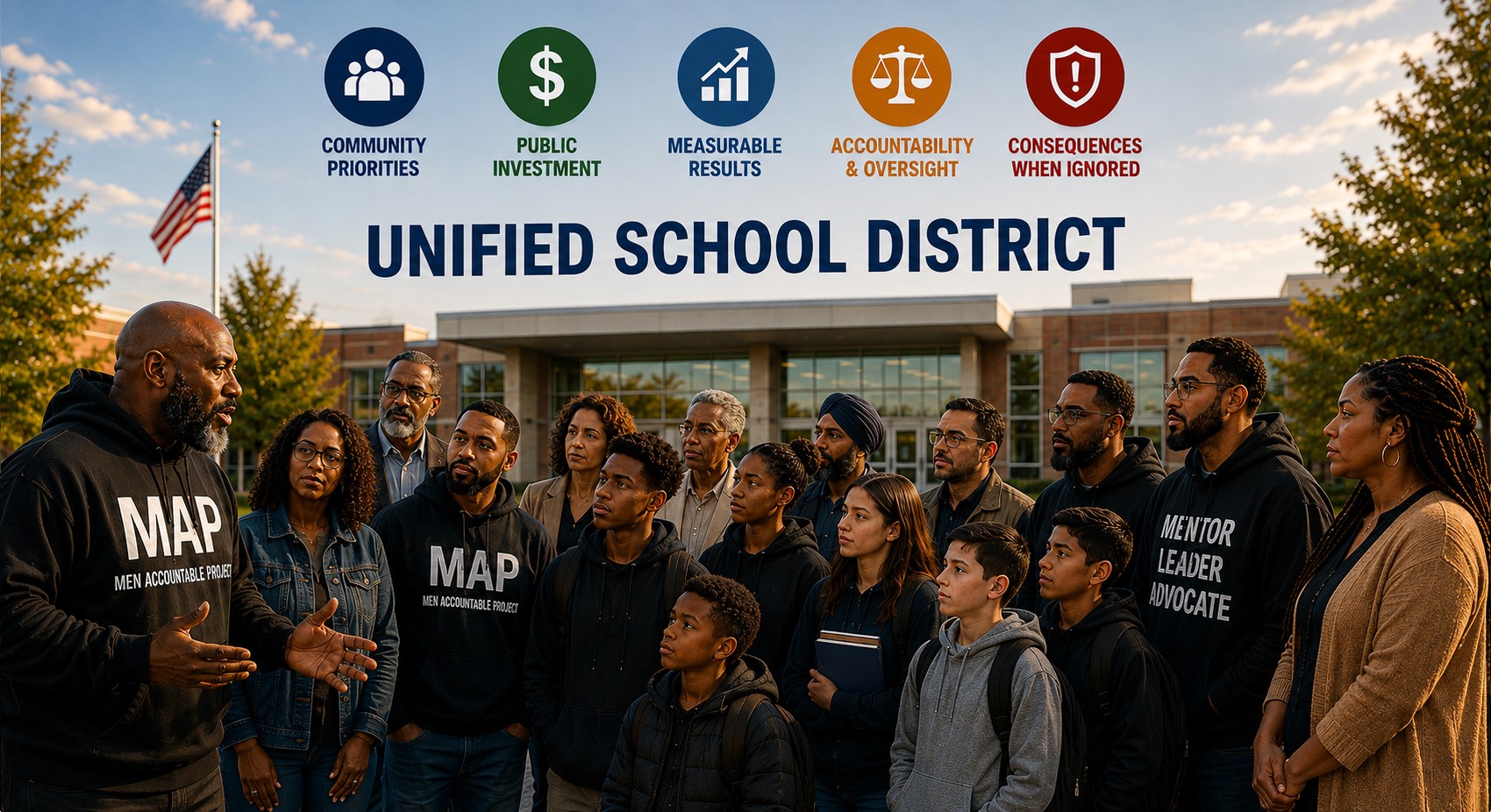
Sacramento does not lack people who care, public spending, programs, or meetings. What has been missing is a structure that connects community priorities, public investment, measurable results, and consequences when results do not follow.
Read the Inc. analysis on California school autonomy → ↗What changes now
People. Mission. Leverage.
Each partner brings capabilities the others should not have to build from scratch.
Leadership + Process
MAP brings the leadership and process
Visionary leadership, a proven process, organization, accountability, and the ability to bring the right people and resources together to get results.
Mission + Knowledge
Education partners bring mission knowledge
Participating education partners contribute issue knowledge, community relationships, and experience with the needs affecting students and families.
Leverage + Accountability
PHIERS brings the leverage
Organizing infrastructure that turns community priorities and participation into measurable accountability and pressure for results.
Together
People + Mission + Leverage
We organize around what the community wants, bring proven solutions to the table, and hold the people with authority accountable for results.
How the accountability system works
Here's how we make sure they have to pay attention.
We get clear about what we want, put people behind it, take it to the people in charge, and keep score.
The Accountability Rhythm
Five simple questions that keep the public in the loop
Hover or tap each question to reveal the full accountability journey.
What was promised?
▼What was funded?
▼Where did the money actually go?
▼What was implemented?
▼What results were achieved?
▼Promise → Resource → Action → Outcome → Change
The PHIERS Accountability Model (PAM).
Then we keep asking those same five questions — every time public money is supposed to help our children.
If the answers do not add up, we do not just move on to the next meeting. We put the gap on the record: what they said would happen, where the money went, who made the call, what actually got done, and what results our children got.
Then we act on what the record shows. That can mean demanding a better plan, moving money toward what works, stronger oversight, complaints, requests for investigation, making the record public, pressing the people who appoint officials, or organizing to replace elected leaders who will not do the job.
Who has power in this system
Organized people are more than volunteers.
They are voters, parents, students, educators, mentors, neighbors, and organizations — and their signatures, survey responses, participation, and votes create the public power behind PHIERS.
Decision-makers are accountable for decisions and results.
Trustees, district leaders, county officials, elected representatives, candidates, and appointed officials with authority over funding, policy, staffing, oversight, and implementation should know what the organized community expects — and what they will be measured against.
The people are not just being asked to help schools. They are organizing to define better performance — and hold the people with authority accountable for producing it.
From Community Power to Public Investment
Accountability is not only about watching where the money went.
It is also about helping shape what gets funded in the first place.
Community priorities → Organized support → Decision-maker commitments → Funding decisions → Services delivered → Measurable outcomes
Survey — Direction. Public Trust Petition — Strength. Covenant — Commitment. The PAM — Accountability.
The PAM works wherever the public deserves an answer—from schools, boards, and districts to cities, counties, state agencies, Congress, and any public office or agency that owes the people an answer. It drives the follow-through and holds decision-makers to the public record—tracking answers, promises, actions, results, and refusals.
What we're organizing around
This is not just a parents' fight.
Parents, educators, students, mentors, tutors, role models, neighbors, organizations, and community leaders all have a lane.
Everyone has a role. Everyone has a responsibility.
This Is Bigger Than One Meeting
We already know many of the things that can help. Now we organize to get them done.
The petition tells us how many people are willing to stand behind change. The survey tells us what the community wants addressed. Next, we put proven solutions behind those priorities, bring the right people and organizations to the table, and ask the people with authority and resources for near-term commitments and measurable results.
Many of the organizations and people Sacramento needs are already doing valuable work. The opportunity is not to replace them, but to connect the right people, resources, information, and accountability around priorities the community has identified.
The goal isn't simply more programs. It's better coordination around measurable outcomes.
School health. Literacy. Mentoring. Tutoring. Coordinated interventions. Family support. Responsible spending. Public accountability.
This work does not have to wait for another school year. The school year has already started.
Why spreading the word matters now
500 qualifying Public Trust Petition signers in one congressional district is the House organizing trigger.
PHIERS formally delivers a public town-hall request. PHIERS demands a substantive initial response within three calendar days of documented delivery. The PAM drives follow-through, records the response or nonresponse, and the people decide what lawful political action comes next.
Why 500 in a district?▼
Five hundred qualifying Public Trust Petition signers in one congressional district build visible district strength. The Survey supplies direction, the Petition supplies strength, the Covenant supplies commitment, and the PAM drives accountability.
PHIERS is much bigger than schools. Its purpose is to strengthen the safety net, the economy, and the lives of individuals, families, and communities — nationwide and beyond.
MAP is leading the community work. Participating education partners contribute issue knowledge and relationships. PHIERS supplies the accountability and solutions architecture.
MAP is applying the PHIERS Accountability Model (PAM): the Sacramento Survey identifies local priorities; the Public Trust Petition separately builds organized public strength; the Covenant requests a clear commitment; and the PAM demands answers and tracks the response and results.
The instruments support the same accountability process without becoming interchangeable. A Petition signature does not by itself endorse a specific Sacramento program.
That is why we are asking people to spread the word.
The faster each district reaches 500 qualifying Public Trust Petition signers, the faster we can move from concerns to an on-the-record response—and from promises to measurable results.
Powered by PHIERS
We were doing this work more than a decade ago. See PHIERS' record in school-based health, school nurses, whole-child support, community partnerships, and measurable outcomes.