
The Founder's Story
Why PHIERS Exists
Every meaningful project begins with a question.
Not a slogan. Not a campaign line. A question that kept returning until the shape of the answer became impossible to ignore.
I didn't wake up one morning and decide to build a movement.
I spent years asking a different question.
Why do communities struggle to solve problems together?
I watched the way this country talks about who deserves to make it — the winners, the builders, the ones who pull ahead — and underneath it, the quiet assumption that everyone else is just weight to be carried.
I knew where that leaves my people. It leaves us behind.
So I stopped waiting for an order built to exclude us to change its mind. I started building one that already includes us — a way to turn what we already have into what we need, and to hold power accountable through peaceful, lawful means.
That question led me through healthcare, economics, public policy, technology, nonprofits, education, labor, transportation, faith communities, and government.
Every field explained part of the problem. None explained the whole system.

The Search
Curiosity became frustration.
Looking for the Missing Piece
The deeper I looked, the more one pattern kept repeating.
Communities weren't failing because people didn't care. They weren't failing because organizations weren't working.
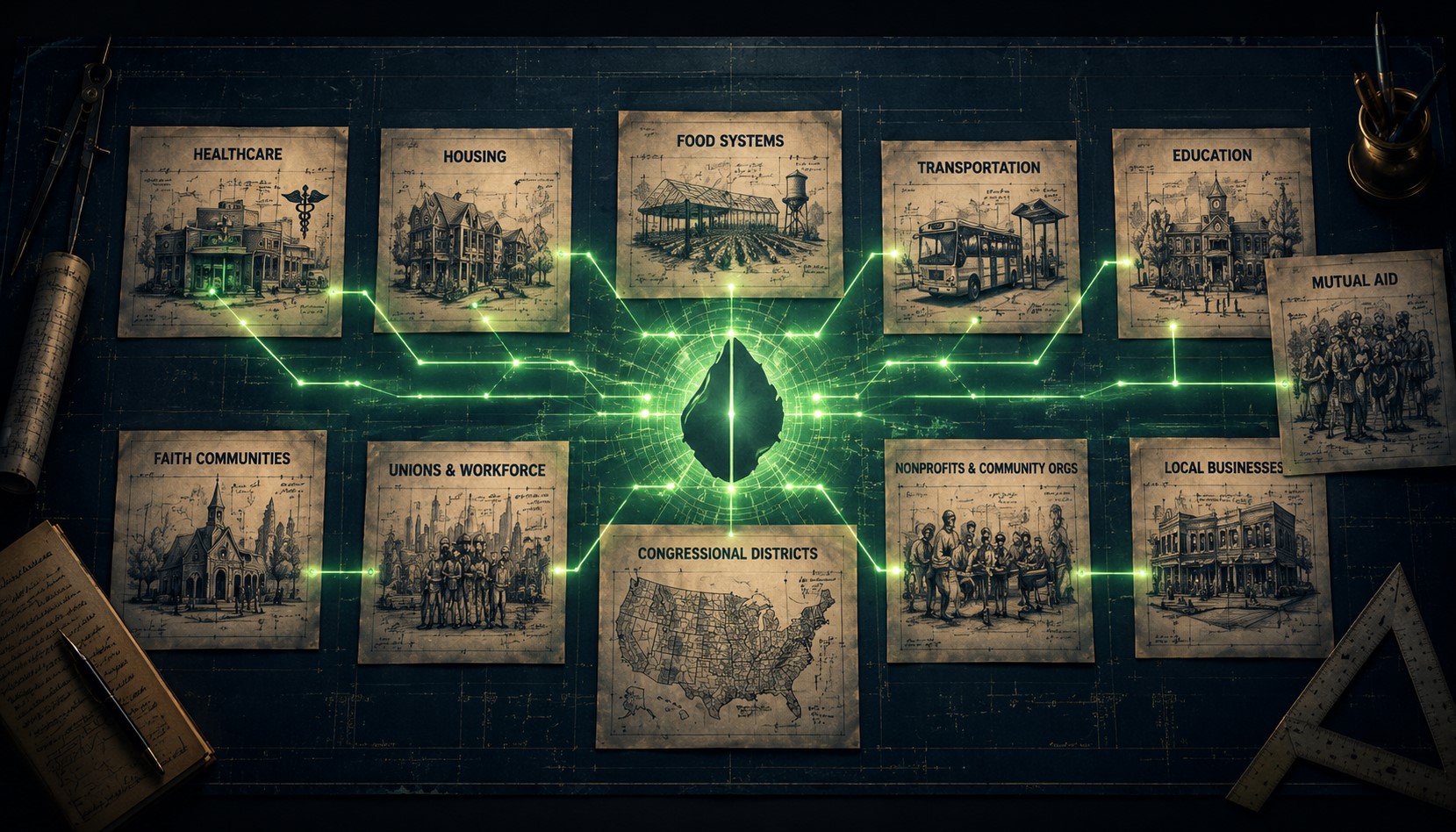
They were struggling because nearly every organization was trying to solve its own piece of the puzzle without a shared way to coordinate with everything around it.
Each mattered. Each created value.
But too often they operated beside one another instead of through one another.
The missing piece wasn't another organization.
It was the infrastructure connecting them.
The Insight
Frustration became revelation.
The Idea That Changed Everything
The moment I stopped asking,
“How do we build a better organization?”
and started asking,
“How do we help existing organizations work together?”
everything changed.
The answer wasn't another nonprofit. It wasn't another political organization. It wasn't another social network. It wasn't another petition website.
It was infrastructure.
A civic operating system communities could build together—one that allowed every existing organization to become more effective without replacing any of them.
PHIERS isn't designed to compete with good organizations.
It's designed to connect them.
The Organizing Unit
Revelation became logic.
Why Congressional Districts?
Congress already organizes America into congressional districts.
Every district already contains:
The challenge isn't finding people who care. It's helping them see one another.
When districts organize themselves around shared priorities, communities gain something they've rarely had:
A coordinated voice.

The Vision
Logic became hope.
Out of Many, One
Every congressional district is different—different geography, politics, cultures, and priorities.
That's exactly why PHIERS doesn't tell districts what to care about. Communities decide that for themselves.
PHIERS provides the infrastructure that allows neighbors, organizations, and institutions to identify shared priorities, organize around them, and present them to Congress with one coordinated voice.
A union. A mutual-aid network. A faith community. A clinic. Each one strong on its own — far stronger sharing one road. Not folded into a single organization, and not asked to surrender a thing. Leveraging one another's strengths to survive, and to hold power accountable together.
One organized district at a time.
Until local organization becomes national leverage.
The Commitment
Hope became credibility.
Why I Stayed With It
There were easier projects.
There were more profitable projects.
There were certainly shorter projects.
But once I understood the problem, I couldn't stop trying to solve it.
Because if communities already possess the people, knowledge, compassion, and institutions needed to solve many of their own problems...
...then helping them work together may be one of the highest-leverage things anyone can build.
That's why PHIERS exists.
The Conclusion
We don't need another movement.
We need infrastructure.