SCEC • Men Accountable Project • Men's Healing Circle • PHIERS
A new phase for Sacramento education
Better outcomes. Organized community power. Accountability with consequences.
From local control to community power
California gave districts more discretion.Organized communities need leverage to make accountability match it.
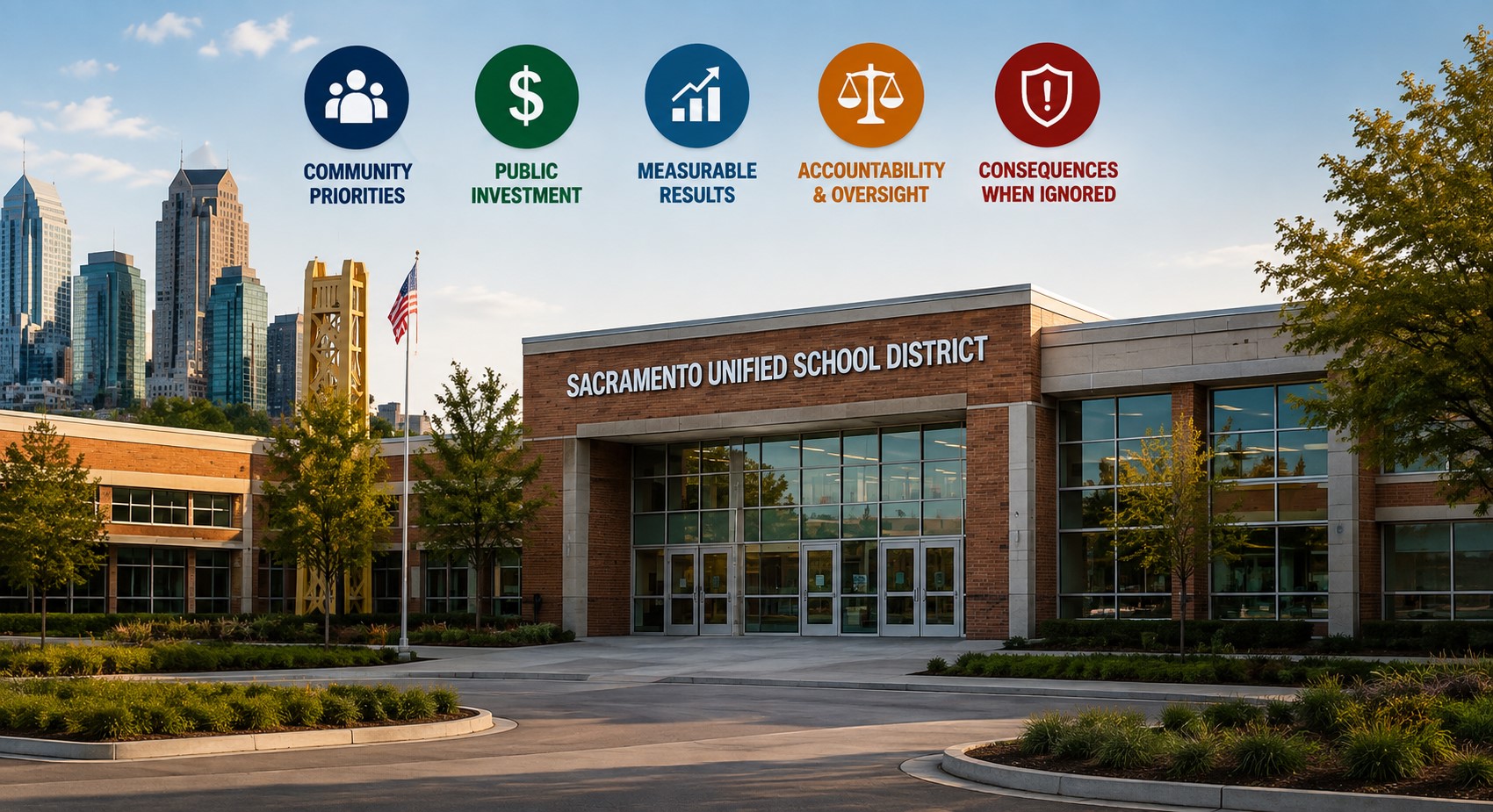
Sacramento does not lack people who care, public spending, programs, or meetings. What has been missing is a structure that connects community priorities, public investment, measurable results, and consequences when results do not follow.
What changes now
People. Mission. Leverage.
Each partner brings capabilities the others should not have to build from scratch.
Leadership + Process
MAP brings the leadership and process
Visionary leadership, a proven process, organization, accountability, and the ability to bring the right people and resources together to get results.
Mission + Knowledge
SCEC brings the education mission
Years of advocacy, relationships, literacy priorities, and knowledge of the issues affecting students, parents, and the community.
Leverage + Accountability
PHIERS brings the leverage
Organizing infrastructure that turns community priorities and participation into measurable accountability and pressure for results.
Together
People + Mission + Leverage
We organize around what the community wants, bring proven solutions to the table, and hold the people with authority accountable for results.
How the accountability system works
Here's how we make sure they have to pay attention.
We get clear about what we want, put people behind it, take it to the people in charge, and keep score.
The Accountability Rhythm
Five simple questions that keep the public in the loop
Hover or tap each question to reveal the full accountability journey.
What was promised?
▼What was funded?
▼What was actually spent?
▼What was done?
▼What changed?
▼Promise → Resource → Action → Outcome → Change
The PHIERS Accountability Model (PAM).
Then we keep asking those same five questions — every time public money is supposed to help our children.
If the answers do not add up, we do not just move on to the next meeting. We put the gap on the record: what they said would happen, where the money went, who made the call, what actually got done, and what results our children got.
Then we act on what the record shows. That can mean demanding a better plan, moving money toward what works, stronger oversight, complaints, requests for investigation, making the record public, pressing the people who appoint officials, or organizing to replace elected leaders who will not do the job.
Who has power in this system
Organized people are more than volunteers.
They are voters, parents, students, educators, mentors, neighbors, and organizations — and their signatures, survey responses, participation, and votes create the public power behind PHIERS.
Decision-makers are accountable for decisions and results.
Trustees, district leaders, county officials, elected representatives, candidates, and appointed officials with authority over funding, policy, staffing, oversight, and implementation should know what the organized community expects — and what they will be measured against.
The people are not just being asked to help schools. They are organizing to define better performance — and hold the people with authority accountable for producing it.
What we're organizing around
This is not just a parents' fight.
Parents, educators, students, mentors, tutors, role models, neighbors, organizations, and community leaders all have a lane.
Everyone has a role. Everyone has a responsibility.
This Is Bigger Than One Meeting
We already know many of the things that can help. Now we organize to get them done.
The petition tells us how many people are willing to stand behind change. The survey tells us what the community wants addressed. Next, we put proven solutions behind those priorities, bring the right people and organizations to the table, and ask the people with authority and resources for near-term commitments and measurable results.
School health. Literacy. Mentoring. Tutoring. Coordinated interventions. Family support. Responsible spending. Public accountability.
This work does not have to wait for another school year. The school year has already started.
Why spreading the word matters now
1,500 signatures is the target.
Once we reach 1,500, we have a documented constituent mandate to demand a public town hall with elected officials.
Why 1,500?▼
1,500 is not a magic number. It is a leverage threshold.
PHIERS is much bigger than schools. Its purpose is to strengthen the safety net, the economy, and the lives of individuals, families, and communities — nationwide and beyond.
SCEC is where the Men Accountable Project (MAP) is putting that model to work first.
MAP is applying the PHIERS Accountability Model (PAM): use a constituent survey to establish what people want, use a petition to put those demands on the record, and use five key questions to measure what happens next.
The petition and survey work together. The survey tells us what constituents want. The petition shows how many constituents are standing behind it.
That is why we are asking people to spread the word.
The faster we reach 1,500, the faster we can move from concerns to accountability — and from promises to measurable results.
Powered by PHIERS
We were doing this work more than a decade ago. See PHIERS' record in school-based health, school nurses, whole-child support, community partnerships, and measurable outcomes.